I woke to snow. It was laying across the roofs of the city which were twenty one floors below my window, and the shadow of the tower block in which I was accommodated fell halfway up the street in front of us. It fell past the railway line, through the pop up market and all the way to Starbucks where we were due to gather with other tourists (for that is what we were, no other name for us) to meet our tour guide, who would be taking us on a walk around the city and pointing out areas of interest relevant to the Second World War and the rise of the Nazis.
Sounds like a fun day out doesn’t it? I always try to be a little light hearted in these ramblings, but with such a heavy subject please forgive me if my sense of humour sometimes slips on this occasion.
Our tour guide turned out to be Scott, an artist from Glasgow who had lived in Berlin for five years. He wasn’t quite what I’d expected, I have to be honest, but my initial reservations turned out to be unfounded as he could tell a story and was a mine of information about everywhere we visited. For example, he knew that Starbucks was NOT on the list of interesting or relevant places, so once our little assembly of ten or so gathered together, and Scott had given us a few facts and figures about the impact of the war on Berlin, we walked round the corner to the Old Jewish cemetery.
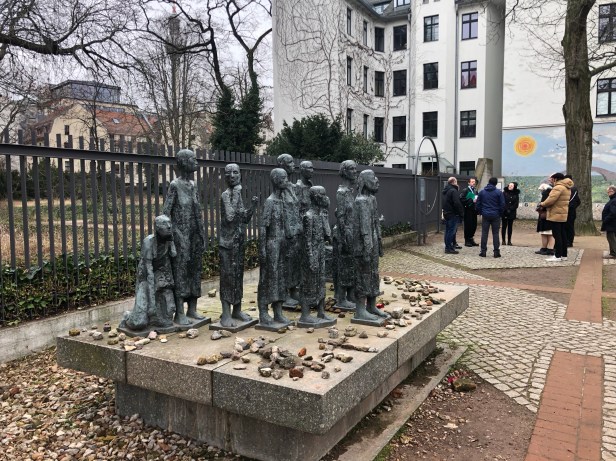
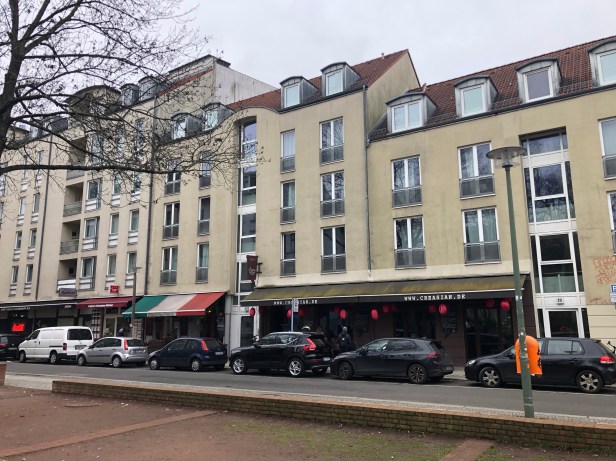
Imagine our surprise when we stopped outside the very restaurant that we’d had a meal in last night. Eighty years before we could be found ploughing our way through a Thai Red Curry, it was the first building in Berlin that the SS had turned into a ghetto. It once had barbed wire and armed guards outside, and was floodlit 24 hours a day. Where we had stopped this morning is a Jewish cemetery. On one dark day, the Jews who had been incarcerated in that building were marched out, across the road, and forced to smash up the headstones on all the graves of their ancestors.
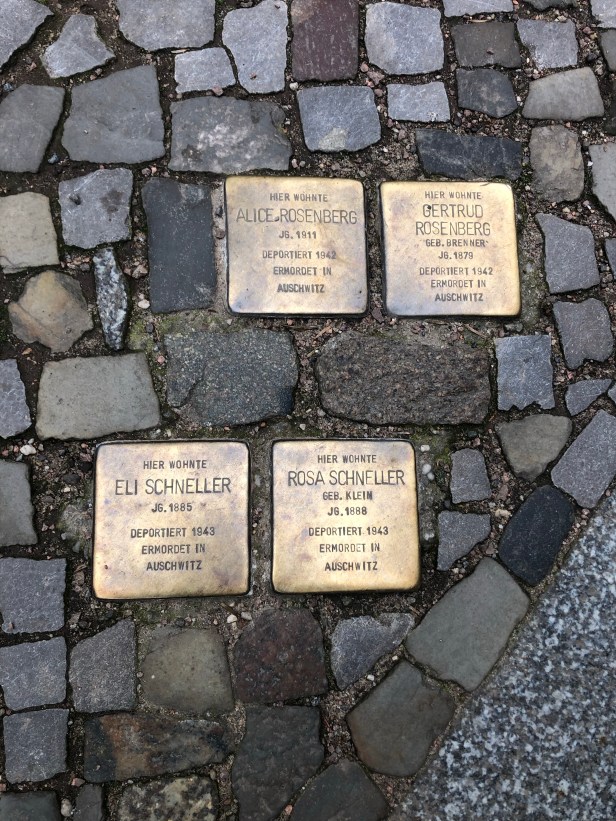
Round the corner from there was an apartment building which was one of the few buildings in the city where the bullet holes from the battle of Berlin had been left untouched. Outside the door of the flat were four little plaques, which had been put there after the war commemorating the families who had been evicted from that very apartment and sent to a concentration camp. Each plaque ended with the phrase “Murdered in Auschwitz.”
The Nazis didn’t quite get it all their own way all the time though. There was the inspiring story of a policeman who confronted the Brownshirts outside a synagogue on what has become known as Kristallnacht, when all Jewish owned property was smashed and hundreds were assaulted or murdered on the streets. This heroic policeman faced down the mob with a fabricated story about the dangers of destroying the synagogue, telling them that to set fire to it would also ignite the rest of the neighbourhood as all the buildings were connected. The Brownshirts put their collective brain cell together and they believed it, going off in search of other victims, no doubt dragging their knuckles on the pavements as they went. If that policeman’s ploy hadn’t worked, he would’ve been lynched. But because of him, the synagogue stands today.
We then caught the U-Bahn train to Anhalter Banhof and I have to say I was more than a little surprised when it broke down. I had subscribed to the cliched opinion that trains in Germany were always on time and very efficient. It was good to know that they had more than a passing similarity with the Newcastle Metro system.
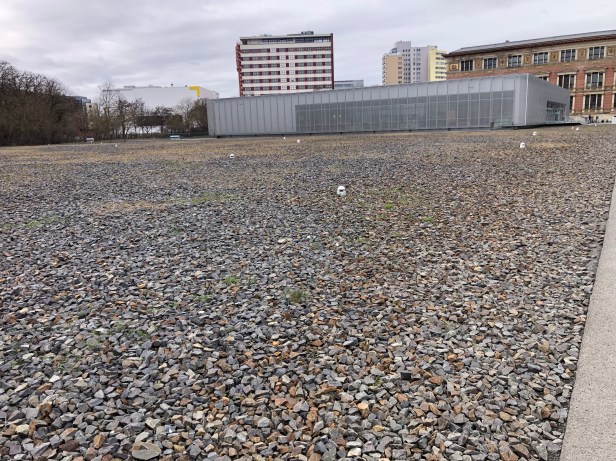
We emerged near the site of the old Gestapo HQ. (Wow, this is a fun blog, isn’t it? Still with me? Good). Thankfully, the Gestapo had long since been seen off by the RAF, and most of the site where their building was is now an open, gravelled area, the exception being a steel grey block in one corner which now houses the cleverly titled “Topography of Terrors” museum. Inside, there is a display of photographs and models detailing the rise of and the crimes of the Nazis.
I’d been there before, on a previous visit. I got half way round it this time and confess that I had to stop. It was all so overwhelming, and made me feel a little sick. But it’s an important lesson and plays a vital role in the education of our youngsters.
The last straw for me was a photograph of a group of men and women at what looks like a summer holiday camp. The lads have a cheeky smile on their faces and the girls look like they can’t control their laughter at something one of the boys has said. As if they hadn’t a care in the world.
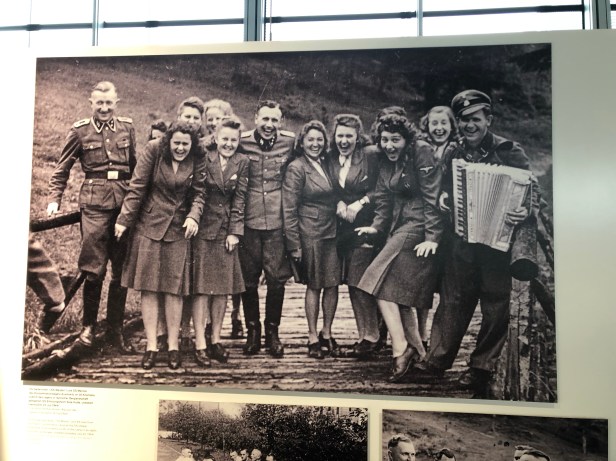
They were Auschwitz Guards on a summer break.
It was too much for this sensitive soul so I consoled myself with a coffee and a cake in the tea rooms, trying to ignore fact that I was in the place where the Holocaust had been planned. Never mind a sense of history; this was more of a stench.
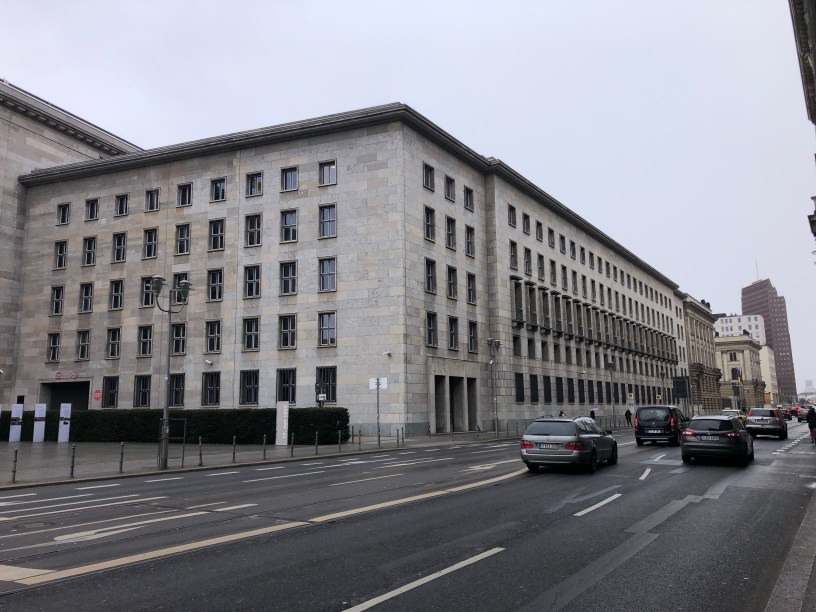
Fortified a little by the coffee, we moved on, for just around the corner to the only Nazi building to have survived the RAF’s attention. It’s huge grey edifice which was constructed as Reichsmarshall Goering’s Luftwaffe Headquarters. How ironic that the only building that the RAF missed was that of their counterparts.
Opposite that building now is a compound full of cardboard cars, or “Trabants.” They were unreliable, uncomfortable, and expensive, but were popular amongst the citizens of East Berlin in Cold War days. The compound exists as a tourist attraction nowadays, as the vehicles were available for hire. A far cry from the days when a select few citizens of East Berlin had to wait up to 13 years to obtain one. Of course, there was no Amazon Prime then.
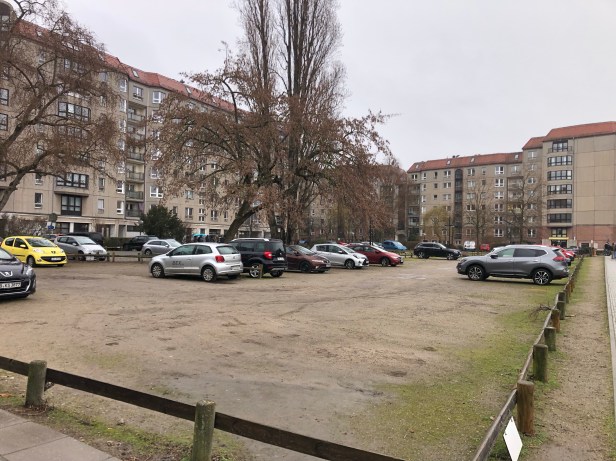
The next stop was a car park. Despite that, this cheered me up a little, because we were standing on the spot where Hitler did the only decent thing he ever did, and shot himself. His bunker was below our feet, now filled in with concrete. Above it are a few trees and the odd BMW. And it would’ve seriously annoyed the old despot to know that he died only a few yards from our next stop, the memorial to the murdered Jews of Europe.
This monument is another one that was built on the site of a major Third Reich government office. It consists of over two thousand concrete blocks, of varying heights, and the intention is that you walk all the way through it and come out the other side about three minutes later asking what it was all about. As our guide, Scott, tells us, he believes it comes from a quote from a concentration camp guard who told one of his victims that he shouldn’t ask why he was there; the question “why?’ had no place at Auschwitz. So the artist created this so that people would ask exactly that question. It’s a pretty good theory, but as the creator of the piece has never explained it himself, I think it’s the nearest we are going to get.
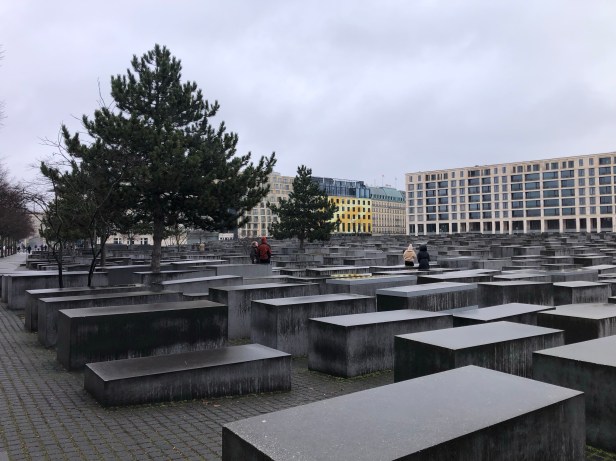
It was oddly disorientating to be in there, and gave me a sense of loneliness. But only for three minutes!
In the Tiergarten over the road, there was yet another monument to Hitler’s victims. This one was for all the murdered gays. It seems the Nazis just hated everybody.
After reading this article, you could be forgiven for thinking that this is a city whose dark past overshadows everything. I don’t want to give that impression, because today it’s a vibrant, liberal and forgiving place with a lot to see and do, and it’s not all about wars and division. I’ll write a bit more about my visit over the coming days and I hope you will agree with me that it’s a much more exciting place than I’ve portrayed here.
For instance, the next one starts with a cake….


Thanks for this,Mr Mobbs. Looking forward to the next chapter. x
LikeLiked by 1 person